


You couldn’t have picked a more mysterious street in England. For six weeks just off Fetter Lane, near where the Knights Templar once allegedly located their headquarter, a who’s who of cryptographers, coders and digital assets experts gave evidence in London’s High Court in 2024.
The primary question at hand wasn’t who Bitcoin’s original founder was, but who the pseudonymous ‘Satoshi Nakamoto’ wasn’t.
The case was brought by the Crypto Open Patent Alliance, a non-profit cryptocurrency group backed by Jack Dorsey, Coinbase and BTC Core with a stated aim to prevent patent hoarding and obstruction of innovation.
Though I will leave the case and its outcome for others to comment on, it did crucially unearth new and historically relevant materials relating to the early days of Bitcoin.
These artifacts have garnered very little interest elsewhere, despite their significance. Here I’ve attempted to outline their importance and explain why they will force a rewrite of Bitcoin’s early history.
First Contact
To begin with, we now have on record Satoshi’s email exchange with cryptographer Adam Back from 2008. The Bitcoin creator had reached out to Back in order to properly cite his Hashcash whitepaper (2002).
A frequent remailer user (an email service which provides anonymity), Back had created Hashcash in 1998 as an anti-spam tool. The algorithm worked by creating a digital signature every time an email would be sent.
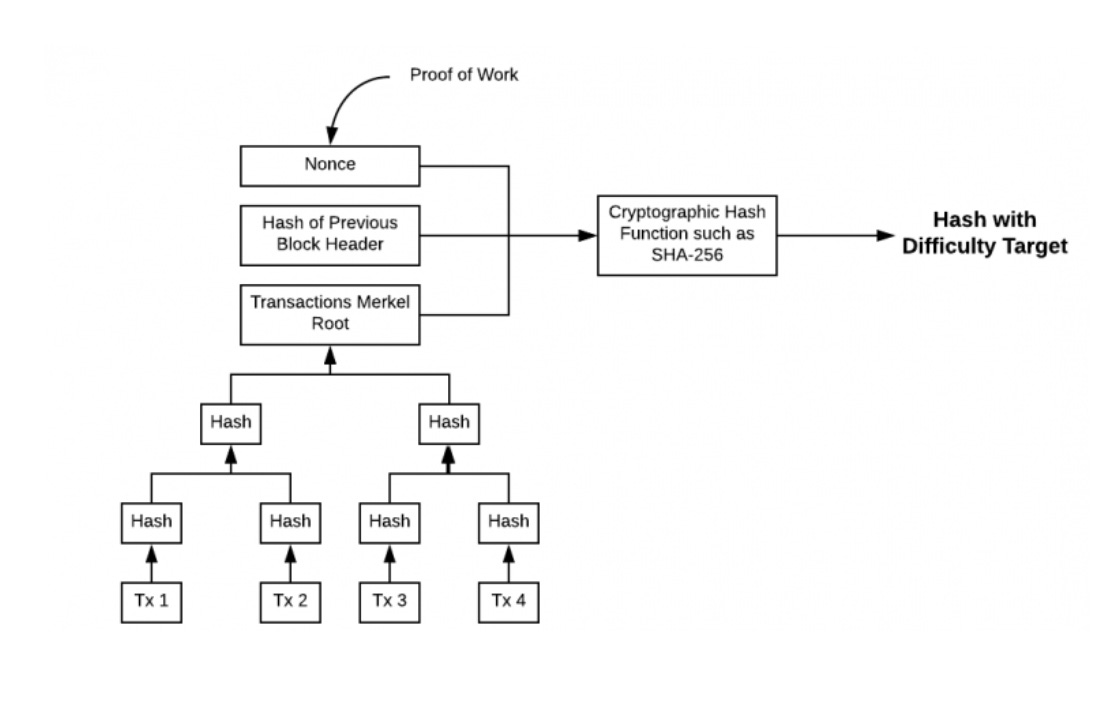
Since it took time and computational power to generate this stamp, its proof-of-work, the micro-costs of Hashcash would deter spammers. Satoshi would integrate the proof-of-work protocol as Bitcoin’s mining function.
The system forces machines (initially envisioned as CPUs) to use their power to solve cryptographic puzzles. For Bitcoin’s use, it expands and verifies a distributed ledger (the blockchain). In doing so, the machine is rewarded with a coin (a Bitcoin) for its work.
We learn from the emails with Back that Satoshi had “nearly” finished the first release of Bitcoin in August 2008 and that they hadn’t heard of Wei Dai’s b-money cryptocurrency system (link).
A bit like Back, the coding came first and then the whitepaper came afterwards for Satoshi (link): “I actually did Bitcoin kind of backwards. I had to write all the code before I could convince myself that I could solve every problem, then I wrote the paper. I think I will be able to release the code sooner than I could write a detailed specification.”
The Marketing
But the most interesting and in-depth revelations from the new disclosures come from a Finnish computer scientist called Martti Malmi.
Otherwise known as ‘Sirius’, Malmi corresponded with Satoshi privately between 2009 and 2011. He helped develop Bitcoin and market the project to the wider world. That work include creating an FAQ, running the Bitcoin.org website and launching one of the first Bitcoin currency exchanges.
As part of the trial in London, Malmi published his email exchanges with Satoshi (link) for the first time. This was a rare and welcome move for Bitcoin researchers.
Given the nature of the project, other Satoshi collaborators have been less forthcoming. For better or worse, they have decided to value privacy over transparency.
Malmi’s contribution therefore substantially extended the Satoshi corpus, which had previously included email exchanges with the nearest thing Bitcoin had to a co-founder, Hal Finney (batch one link, batch two link), developer Mike Hearn (link), the aforementioned Gavin Andresen (link) and Satoshi’s public posts.
Those public communications were across forums (the original SourceForge one, on the P2P Foundation and across the later BitcoinTalk.org site), mailing lists (P2P Research, The Cryptography List and Bitcoin’s dedicated list which Satoshi created) and the Bitcoin Whitepaper itself.
As it stands, no early Bitcoin contributor, developer or supporter has claimed to have interacted with Satoshi other than via non-real-time text communication. Malmi’s disclosure partly reveals why.
A keen user of privacy technologies, including the Tor routing network, Satoshi would sometimes take a break from the early Bitcoin project, put the development of the digital payments technology to one side and then later download his emails [1].
This private admission from May 2010, including that he had “been busy with other things for the last month and a half”, aligns with a gap in his public postings between late March and mid-May 2010.
Satoshi went quiet in the Spring of 2009, with his last public email in March and the next one in October of that year. But the Malmi emails show that Satoshi was active behind-the-scenes, emailing the Finnish developer in May and then in June 2009. Notably, Satoshi also worked on Christmas Day 2009.
The Donors
The other revelation from the now public emails is the existence of early Bitcoin “donors” [2], with one donor offering to send Satoshi $2,000. Malmi would use some of the money to host Bitcoin’s website and help fund his Bitcoin exchange, which the pair had conceived of in a bid to make the cryptocurrency more popular [3].
The emails also give Satoshi assigning a time code (GMT) to their correspondence [4], something that isn’t seen across the rest of the early Bitcoin corpus, and we are given a sense of Satoshi’s wellbeing in mid-July 2010 [5].
They reference a “flood of work” following the exposure this early beta project had been given on Slashdot, something I’ve written about before in relation to Bitcoin (link).
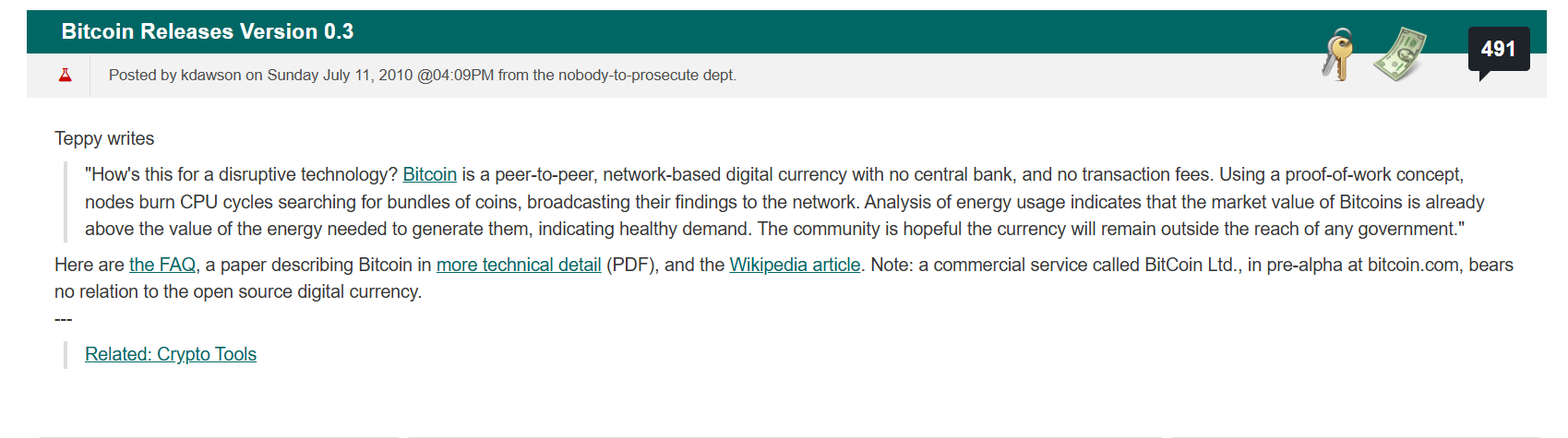
As a popular aggregator in the 2000s tech scene, akin to HackerNews today, tens of thousands of people would have flocked to Bitcoin’s website and forums via Slashdot. That’s the context of Satoshi’s further statement: “I’m losing my mind [,] there are so many things that need to be done.”
They had been fixing bugs, a list of which Satoshi had made from chatter on the BitcoinTalk forum [6], and upgrading the project’s code since 2009, with the original build starting in 2007 well before the Bitcoin whitepaper was published.
To use some of the English Commonwealth dialect Satoshi is known for, the creator seemed knackered by the summer of 2010. Those same sentiments of being stressed out are shared in August 2010 on the Bitcoin forum, when Satoshi apologised for being “so busy lately” and failing to “keep up” (link) with bug fixing.
Earlier that month a hacker had exposed a major vulnerability in the Bitcoin system and created two lots of 92 billion Bitcoins, far beyond the 21 million Bitcoin cap. The ‘value overflow incident’, as it was later dubbed, could have cratered the project then and there.
To overcome the issue, the developers patched the Bitcoin software [7] and the technology’s community agreed to perform a ‘hard fork’, moving to a new system with new rules. Bitcoin survived. But, as it stands, this was the most serious bug in the technology’s history.
By the second half of 2010, a new Bitcoin exchange, MtGox, had launched, the project was getting noticed on Wikipedia, with a dispute erupting between the technology’s users and Wikipedia editors (link), and the first retail transaction had been recorded when developer Laszlo Hanyecz exchanged 10,000 Bitcoin for two pizzas.
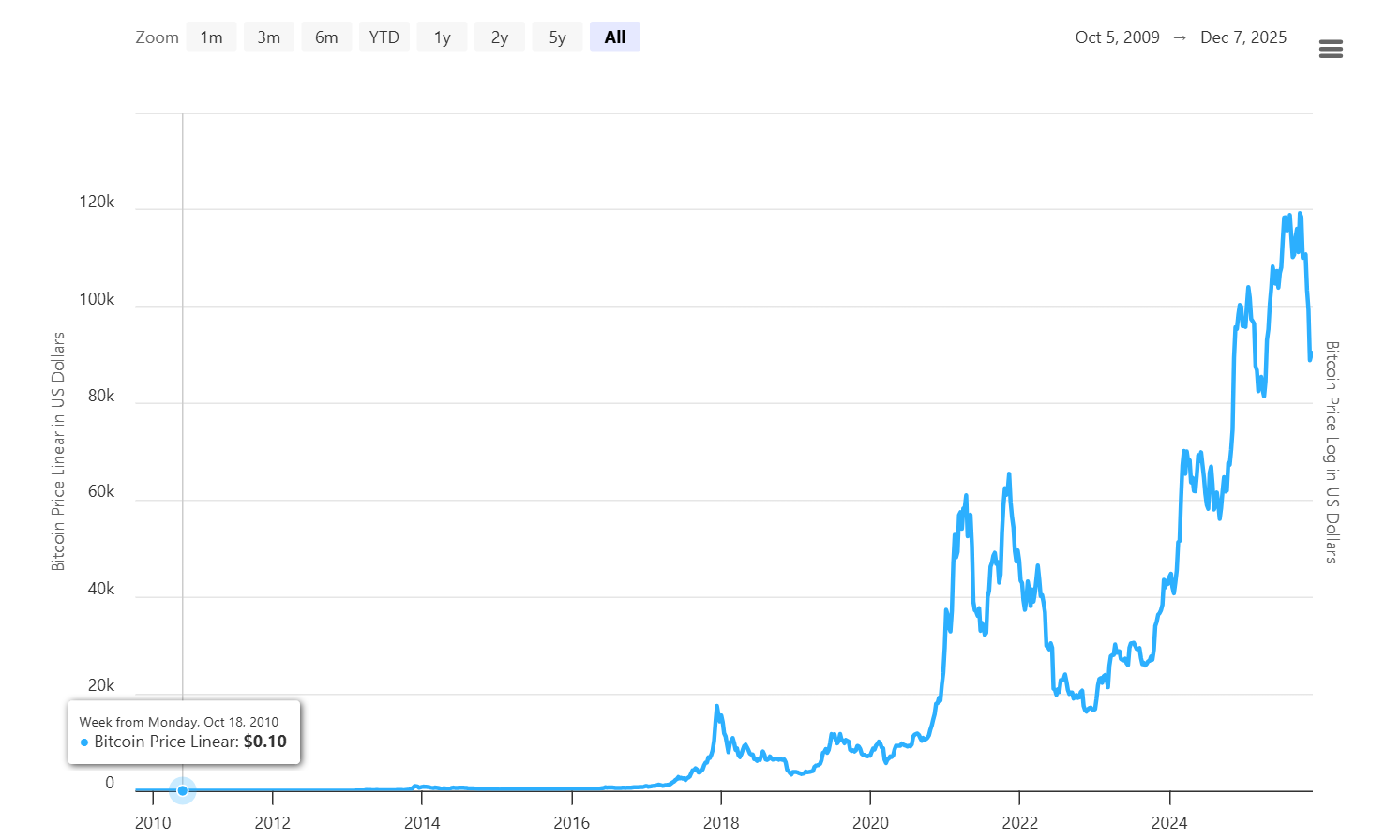
Though Bitcoin’s price was just around $0.10, further interest in the project grew thanks to posts on Reddit (link) and community-driven sites literally giving away Bitcoins (link).
As the year came to a close, Satoshi was concentrating on fixing bugs, upgrading the software, overseeing the translation of the project into multiple other languages and delegating responsibilities to the other Bitcoin developers.
The Overflow Incident
But there was a touch of drama before the year was out. Amid speculation that WikiLeaks could start accepting donations via Bitcoin, Satoshi took to the forums in December 2010 to make a public appeal (link): “Bitcoin is a small beta community in its infancy. You would not stand to get more than pocket change, and the heat you would bring would likely destroy us at this stage.”
Remember, the value overflow incident had happened just four months earlier. One of Satoshi’s final public posts was to flag that he was planning to ‘venture into more complex ideas’ (link).
He also announced that the next patch of the Bitcoin software would concentrate on denial-of-service (DoS) resistance, no doubt this was in reaction to the new found fame the project had attracted on the internet.
The early Bitcoin developers had previously warned that the software was vulnerable to these types of rudimentary cyber assaults (link), where an attacker floods a machine(s) with a mass of superfluous requests making its services unavailable often for a finite period of time.
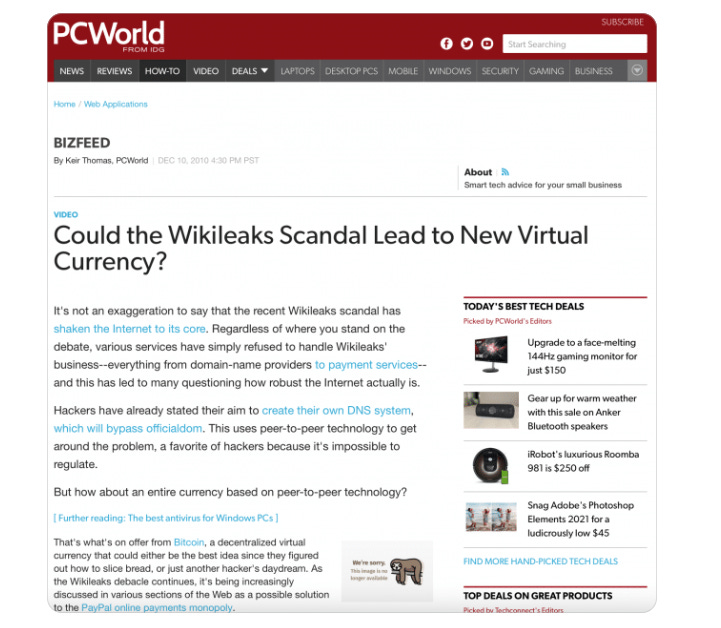
The DoS upgrade also followed Satoshi’s own warning on 11 December: “...WikiLeaks has kicked the hornet’s nest, and the swarm is headed towards us.” The remarks were in response to a PC World article on Bitcoin authored by Keir Thomas (link).
Headlined ‘Could the Wikileaks Scandal Lead to New Virtual Currency?’, the post drew some unwanted attention to the project and associated it with a political hot potato. It’s unclear whether this was the straw which broke the camel’s back for Satoshi, who subsequently stopped posting publicly.
But we do know that Satoshi was around 42 months into the project, having first started working on Bitcoin in mid-2007, and some of the most important aspects of the organisation had been delegated to a trusted core group of developers by mid-2010.
The Malmi emails are important because they show that Satoshi seemed aggravated by the workload associated with upgrading Bitcoin by the summer of 2010, even before the value overflow incident occurred.
They also corroborate testimony from other Bitcoin insiders that Satoshi did continue to communicate privately in early 2011, often using terse responses to Malmi and Andresen [8].
The Malmi archive stops in February 2011, but Andresen and Satoshi would continue their exchanges with the Bitcoin creator up to the end of April 2011 (link).
That’s when Andresen announced that he planned to travel to Virginia in June to give a 50-minute-long presentation on Bitcoin. He wanted to make the plan public to the Bitcoin community.
That’s because he wasn’t travelling to any old organisation, but to a subsidiary of the CIA (link). Andresen gave Satoshi a day’s heads-up before going public on the trip. He hasn’t heard from Satoshi since.
End Notes: Satoshi in Context

The wider historical context of Bitcoin’s creation is often overlooked and mischaracterised. Though it launched near the start of the 2008 Financial Crisis, with the Bitcoin network going live in January 2009, Satoshi, by their own account, actually started building the system in mid-2007.
At that time, mortgage defaults were hitting the headlines (link), but the Dow Jones Industrial Average still reached a record high in October 2007. In fact, the early 2000s might have served as a more impactful inspiration for Bitcoin.
The music industry had turned on peer-to-peer music sharing website Napster by 2000 (link), the UK was selling its gold reserves (link), Switzerland was one of the last countries to move off the gold standard in 2000, the Dot Com Bubble had burst by 2001 as BitTorrent launched (link), the War on Terror started in the same year and the Euro began circulating in 2002.
There are currently no accounts of Satoshi mentioning these events, but they provided the political and economic backdrop of the first half of that decade. The other major development was the 2001 Patriot Act.
Created after 9/11, the legislation saw the substantial expansion of the US state and its surveillance powers, raising concerns amongst privacy groups both inside the United States and outside of it. The concerned parties included the Electronic Frontier Foundation, a group which Satoshi was supportive of [9].
Another guessing game amongst digital asset scholars is what projects Satoshi was aware of before building Bitcoin. Adam Back’s pointer to Wei Dai’s b-money is interesting, as is the fact that Nick Szabo’s 1998 Bit Gold concept (link), of a decentralised digital currency, was not mentioned in the Bitcoin whitepaper. Equally, David Chaum’s DigiCash corporation (link), which launched in 1989, was not cited by Satoshi.
This is especially curious since Satoshi hints that they have been learning or developing on the C++ programming language since the 1990s (link), at the same time as the rise of the original cypherpunks (link).
But thanks to Malmi’s archive we do now know that Satoshi was familiar with some other currency projects, including Liberty Reserve (2004), e-Bullion (2001), Pecunix (2002) and Webmoney (1998) [10].
All of this information helps build on the already existing Satoshi profile. That is of a developer or group of coders with a strong knowledge of cryptography, economics, peer-to-peer networks and C++ programming.
On the technical side, we know they preferred the Windows operating system over Linux and used Tor and PGP privacy software systems, sometimes on a seven-year-old computer rig without an AMD or Intel Core i5 processing card.
Somewhat ironically, but as they intended, Satoshi’s hardware wasn’t good enough to keep up with some of the Bitcoin miners on the early network.
References
[1] Satoshi email to Malmi on 16 May 2010. “…just now downloaded my e-mail since the beginning of April. I mostly have things sorted and should be back to Bitcoin shortly. Glad that you’ve been handling things in my absence. Congrats on your first transaction!”
[2] Satoshi email to Malmi on 21 July 2009. “There are donors I can tap if we come up with something that needs funding, but they want to be anonymous, which makes it hard to actually do anything with it.”
[3] Satoshi email to Malmi on 23 June 2010. “I got a donation offer for $2000 USD. I need to get your postal mailing address to have him send to. And yes, he wants to remain anonymous, so please keep the envelope’s origin private.”
[4] Satoshi email to Malmi on 12 November 2009. “Right now (04:50 GMT) my node is connecting to yours and getting zombie connections each time. The socket isn’t returning an error, just zombie without notice. If you’re running the linux build right now, it would be interesting to see what the log says on your side.”
[5] Satoshi email to Malmi on 18 July 2010. “Please promise me you won’t make a switch now. The last thing we need is switchover hassle on top of the slashdot flood of work we’ve got now. I’m losing my mind there are so many things that need to be done.”
[6] Satoshi BitcoinTalk post on 19 September 2010. “I keep a list of all unresolved bugs I’ve seen on the forum. In some cases, I’m still thinking about the best design for the fix. This isn’t the kind of software where we can leave so many unresolved bugs that we need a tracker for them.”
[7] Satoshi email to the Bitcoin developers list 15 August 2010. “*** WARNING *** We are investigating a problem. DO NOT TRUST ANY TRANSACTIONS THAT HAPPENED AFTER 15.08.2010 17:05 UTC (block 74638) until the issue is resolved.”
[8] Satoshi email to Gavin Andresen on 6 January 2011.
“Gavin Andresen wrote:
> I’d be happy to talk to Rainey;
Great
> Satoshi, I assume you don’t want to
> deal with press/PR/interviews ?
True
> We could decline to talk to the press-- Satoshi, I know you’ve
> expressed concern about bitcoin growing too big too fast, and being
> unable to keep up with traffic/attacks/feature requests/etc. But I
> don’t think ignoring the press will make them go away; they’ll just
> talk to somebody else. I think it is better to give a realistic
> impression of bitcoin (it is cutting-edge, beta software that is still
> being developed, it is not poised to replace PayPal or the Euro
> anytime soon, etc) rather than let somebody over-enthusiastic become
> “the unofficial bitcoin spokesperson.”
You’re the best person to do it.
EFF is really important. We want to have a good relationship with them.
We’re the type of project they like; they’ve helped the TOR project and done a lot to protect P2P file sharing.
[9] Satoshi email to Gavin Andresen on 6 January 2011. “EFF is really important. We want to have a good relationship with them. We’re the type of project they like; they’ve helped the TOR project and done a lot to protect P2P file sharing.”
[10] Satoshi email to Malmi on 4 February 2010. “You could always exchange for Liberty Reserve. It’s an online currency similar to e-Bullion, Pecunix or Webmoney that allows exchanges no questions asked and with privacy. LR and the others are hard to buy but easy to cash out. Hard to buy because exchangers are very cautious about getting ripped off by reversed payments, so they require more details and holding time. Cashing out is very easy. LR is non-reversible, so there are oodles of exchanges eager to turn LR into any kind of payment.”