For my American friends, an ‘old banger’ is slang for a slightly rusting, somewhat battered motorcar which, despite its many obvious defects, is still running on the roads.
I’m personally very familiar with ‘old bangers’ since my father stubbornly ran a decommissioned British Gas Van for over a decade.
The faded blue and white Maestro, manufactured by the infamous British Leyland company, was eventually pinched when scrap metal rates hit an all-time high in the early 2010s (link).
Church roofs were being torn apart for their lead fittings on a weekly basis, such was the demand for base metals in those post-Great Recession years.
Unfortunately, there are serious signs in the real economy today (link) that we’re heading again towards a 2008-style reckoning.
This time, however, the problem is slightly more obvious: over-spending and sticky inflation.
We have never really got out of the post-Covid inflation cycle thanks to the crisis in the Middle East, the Russian-Ukraine war and Trump’s trade tariffs, amongst other macro-economic shocks.
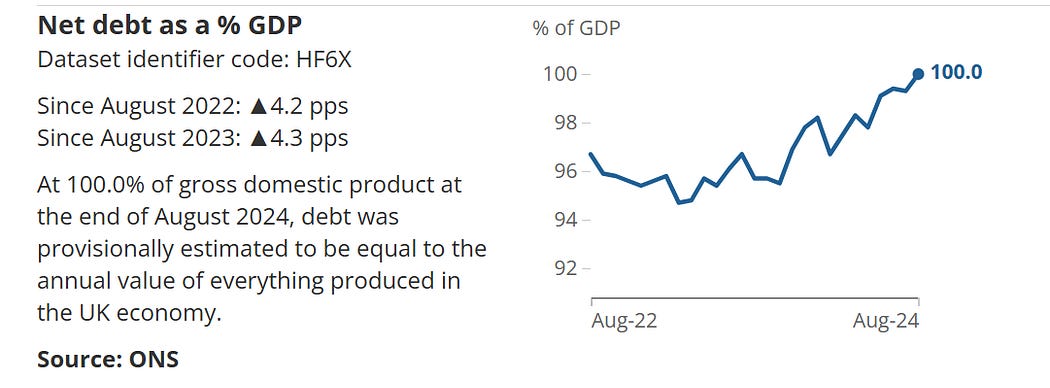
Much like after 2008, the problem is that many Western economies decided to pursue quantitative easing and, at the same time, issue more debt — 100% GDP to debt ratios have now become a norm. Most of the media go along with this, it’s maddening.
Anyway, asset holders have benefited, while economic inequality has expanded. A mortgage, two kids, a house and a car? Forget about it.
Young people aren’t leaving home until their 30s (link). Society can cushion and adapt to these economic blows for only so long.
We’ve been in flux since 2020. Now, with our shaky bond markets, there is new and intensified pressure on workers and savers. Interest rates are likely to rise, zombie small businesses will eventually topple, unemployment will increase.
It’s all rather bad and this time the bogeyman isn’t shaping up to be Wall Street, but Silicon Valley. Data centres, which are a necessary and needed part of our digital infrastructure system, have become a ‘physical embodiment’ of voter fears, as one commentator put it (link).
AI researchers are increasingly claiming that the technology will end the human race, while there’s been a consorted push-back against smart glasses, with objectors dubbing them ‘creepy’.
This is all happening ahead of the October release of Aaron Sorkin’s The Social Reckoning, which appears to be an unflattering take on Big Tech’s approach to child safety. And then we have the US midterm elections in November, when the rhetoric will really ramp-up.
Looking ahead, the situation is looking a bit testy, to say the least. Your local vicarage, in all of its metal-clad glory, might be safe for now, but voters are certainly getting pissed off (link one, link two).
For UK readers, I outlined some specific thoughts on the country's own situation back in 2024. If anything, the economic picture has deteriorated.
Time to call time on Britain’s big state
If there’s a pile of rubbish at the end of the street, a Brit would blame it on the local government, crease their brow and write a strongly worded complaint. An American, meanwhile, would see it as a business opportunity, investment in some cleaning equipment and set-up shop.
There’s something deeply rooted in the current British psyche about always turning to the government to solve your problems. But it hasn’t always been this way. The centralised omnipotent state is very much a product of the mid-2Oth century.
Before World War One, reformers were looking towards Bismarck and a more German model of establishing and professionalising welfare interventions. Lloyd George’s National Insurance Act of 1911 is a good example of this, the Germans having a compulsory national insurance regime since 1884.
Access to these medical benefits were via Approved Societies, allowing for a level of localism and competition. The Act later covered unemployment, allowing British society to move away from the Poor Law system and workhouses — which had existed since the 17th Century in various iterations.
From 1914 to the end of 1918 and then from 1939 until the end of 1945 (not including the hardship and rationing afterwards), the UK effectively had a command and control economy because of the war efforts. With the Germans obviously out of favour, the Beveridge Report of 1942 was adopted by the victorious Labour Party from 1945 onwards.
“Now, when the war is abolishing landmarks of every kind, is the opportunity for using experience in a clear field. A revolutionary moment in the world’s history is a time for revolutions, not for patching.”
The national state apparatus surged in size (non-industrial civil servants reached 716,350 in July 1945) and it was also heavily centralised in the form of various London-based bureaucracies. This was the post-war consensus of 1945 which the victorious British public voted for.
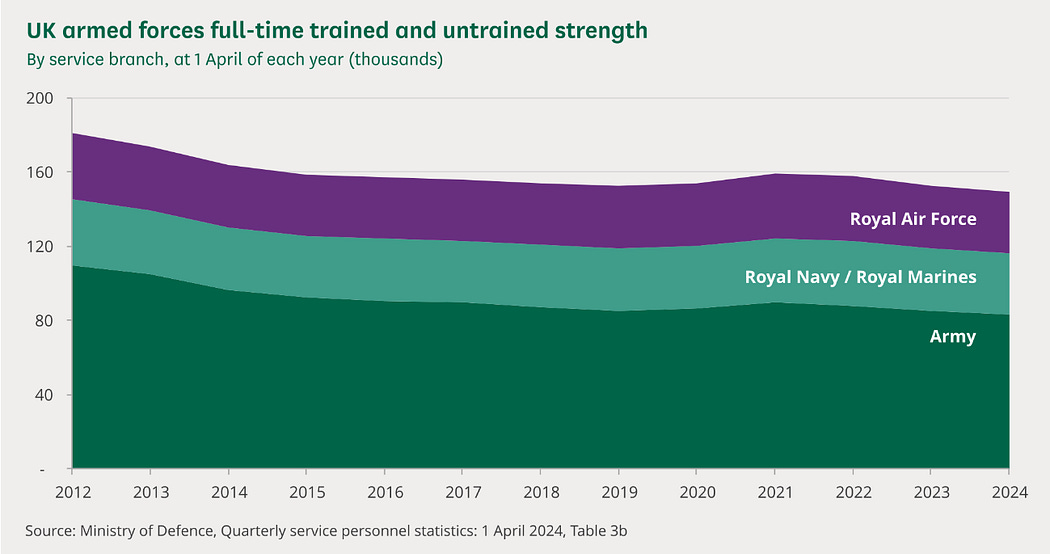
UK society has been shaped by these momentous decisions for the past eight decades. But we’ve got to the point where the state has gone far beyond addressing Beveridge’s five giant evils of idleness, ignorance, disease and squalor (read Julian Le Grand’s 2008 Giants of Excess here), whilst failing to deliver on defence (Armed Forces personnel have been on a steady decline) and crime (actual reported crime has been going up) — the two areas where there is universal support for state interference.
Before the new Labour government’s first Budget was delivered on Wednesday 30 October, the scorecard was as below:
Total public sector employment grew to 5,841,000 in the second quarter of 2024, reaching the highest level since figures started being published in 1999 (link)
Life expectancy in the UK compares poorly to its peers as well as cancer and cardiovascular disease outcomes (link)
Get Ian Silvera’s stories in your inbox
Join Medium for free to get updates from this writer.
Subscribe
Remember me for faster sign in
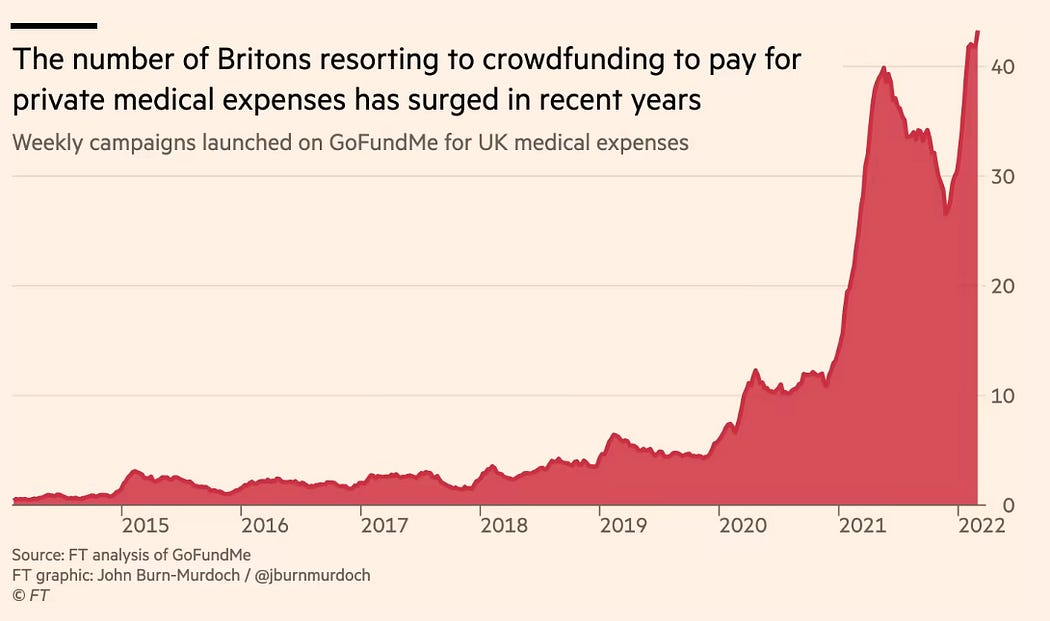
Because of long NHS waiting lists, people are increasingly turning to crowdfunding platforms to pay for operations (link)
The UK has chronically poor productivity rates (link)
On a related note, energy costs are high in the UK compared to its peers (link)
We are left with these outcomes despite more than 18% of total government expenditure being spent on the NHS and a quarter being used for social security (pensions and welfare bills).
Rachel Reeves has now increased the tax burden by £40bn. This is how the Tony Blair Institute described the situation:
This Budget was simultaneously one of the largest tax-raising fiscal events in recent decades and one of the largest fiscal loosenings. The size of the British state will be permanently higher as a result, remaining above 44 per cent of GDP for the rest of this decade (which is almost 5 percentage points higher than before the pandemic).
The state just keeps getting bigger — only the Home Office, Cabinet Office and The Department for Transport will reduce their budgets. All other ministries will increase their spending, amounting to a 4% increase per year between 2023/2024 and 2025/26.
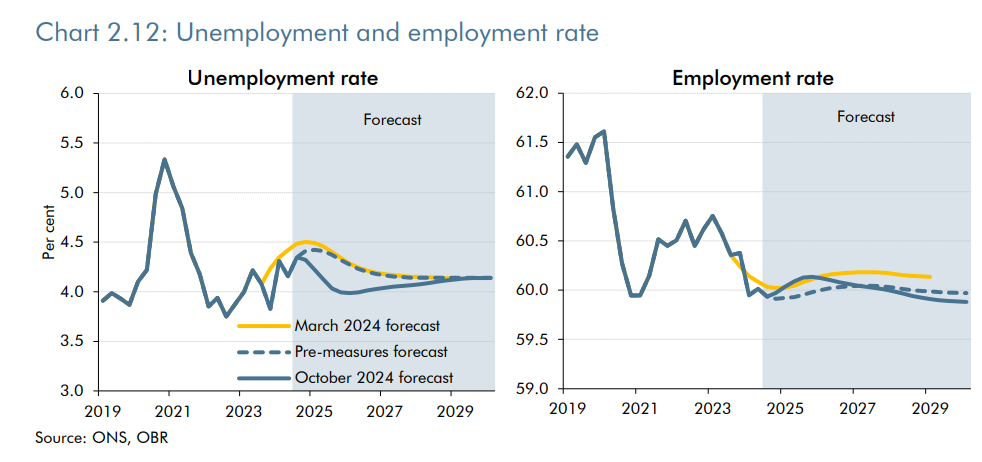
But are the outcomes improved? No, not according to the Office for Budget Responsibility (OBR). It has pointed out that real wages in the UK will be squeezed (thanks to employers passing on National Insurance rises to employees), long-term unemployment, otherwise known as non-participation in the economy, will grow and the employment rate will only rise because of population growth.
On the headline GDP growth forecasts for the UK, the OBR said growth would be 1.8% in 2016, down from 2% in March and 1.5% in 2027, down from its 1.8% prediction in March.
More state clearly isn’t working. And we keep robbing Peter (the aspiring working-classes and middle classes) to pay Paul (the UK’s debt holders). Our debt levels are at more than 100% of GDP, the highest level since the 1960s. And after Reeves changed the UK’s fiscal rules, the markets (effectively made up of international and national investors), aren’t buying it. The end result is that our borrowing costs, including mortgages, will only increase.
After eight decades and amid the excess of tax and spending we now face, it’s time to have a serious think: what do we want a modern national state apparatus to do, how centralised should it be and where should it get out of the way of civic society?