


We’re deep into the Larger Trinity season here in the UK. The World Championship of Darts is being played out, in all of its dress-up, sing-along glory, at North London’s Alexandra Palace (link).
England have just been thrashed by the Aussies at the cricket (it’s been truly woeful), and all tiers of the association football pyramid – the Premiership, Championship and lower leagues – are cramming in game after game, leading up to a Boxing Day bonanza (link).
Millions will flock to the terraces and tune in over a plate of reheated leftovers on the 26th, and they might even multi-screen some horse racing while they’re at it.
Thanks to blokes live sports is in rude health both in Britain and the US, where households still watch the NFL, basketball and baseball together (link). But elsewhere the story of the online man isn’t a straightforward one.
Prompted by the now viral The Lost Generation essay from Jacob Savage in Compact (link), which painfully lays bare Hollywood’s discriminatory practices under the banner of the optic-inducing Diversity, Equity, and Inclusion framework, I wanted to find out how men were consuming, embracing and rejecting content.
With live sports aside, it’s a fairly negative outlook for traditional media. Though trust in the news media is on the decline generally and across all demographics (link), men take an especially less favourable view of the journalism industry.
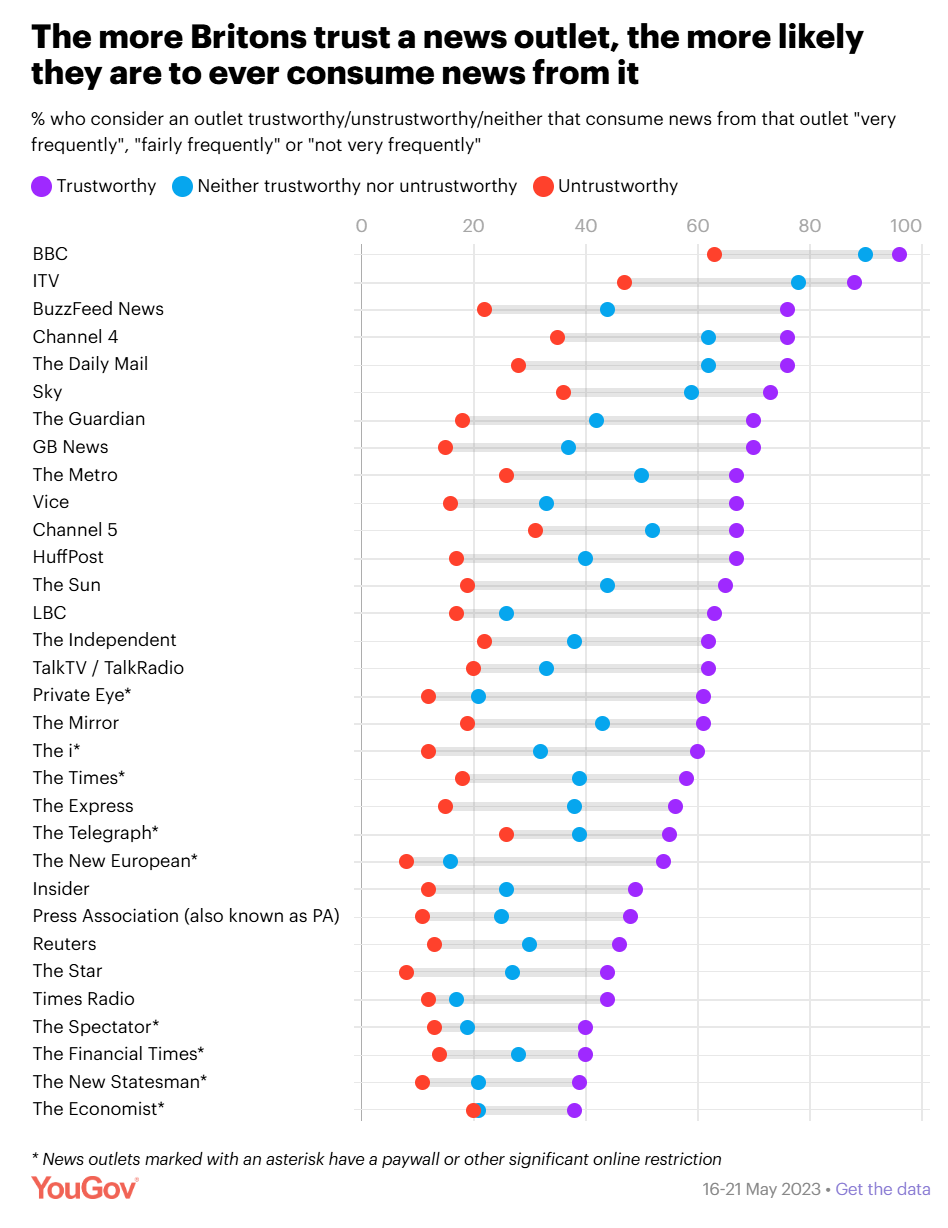
When I looked into the tables from a 2023 YouGov poll, for instance, for every major UK broadcaster men trusted them less than female viewers (link). This was even true for the BBC, which typically scores very high favourability ratings.
Asked ‘how trustworthy or untrustworthy do you rate the news reported by the following media organisations?’, male respondents gave a net rating of 20 versus 26 from women for the broadcaster.
When you add age to the equation, you might expect older men – insert the old man yells at cloud meme – to be particularly distrustful of the news media. According to a major Gallup poll of US voters (link), that isn’t the case.
It’s Millennials, as Jacob Savage alluded to, which no longer align their values with mass media, scoring a record low 23 on Gallup’s 100-point trust index.
Bearing in mind that these are the management classes, the ones with all of the disposal income, that’s quite an indictment for Hollywood and the journalism industry.
Gen Z and those over 50 both ranked at 28, while the boomers gave mass media a lot of trust with a score of 43.
So we know that the online man, especially of the Millennial variety, embraces live sports streaming, whilst strongly rejecting other forms of mass media. But where exactly are they on the internet?
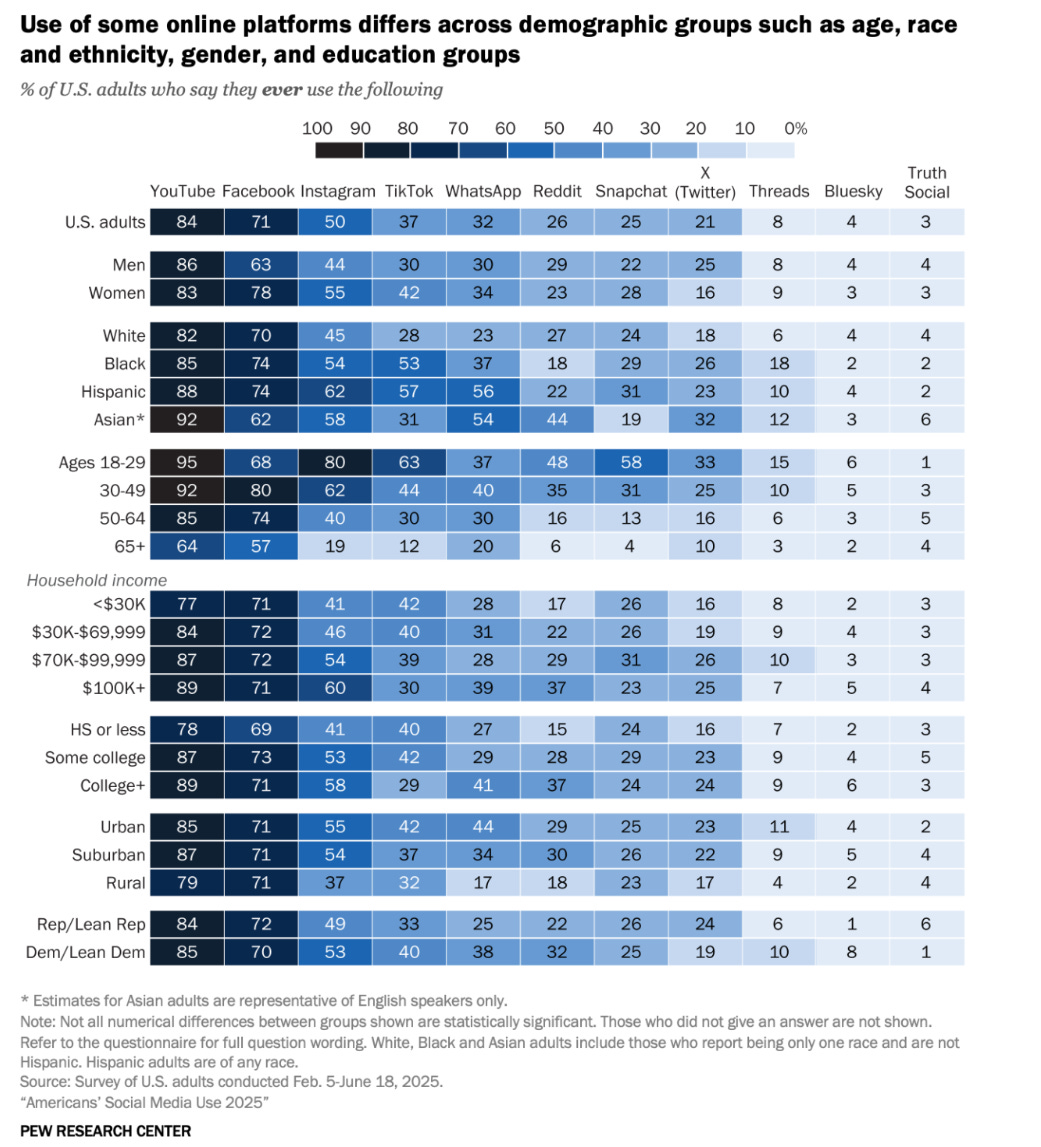
Increasingly, it’s on the lad-laden technology stack of YouTube, Reddit and X. YouTube is universally used across all age, gender, race and geographical brackets, but men especially favour the Google-owned video platform.
Studies from YouGov (link) and PewResearch (link) not only show that YouTube is a favourite, but that podcasts are a preferred form of content. Naturally, creators such as Joe Rogan, Chris Williamson and Shawn Ryan come to mind since they all have blokey offerings.
But all of the most popular pods, including Goalhanger’s Rest is History, are moving onto the platform with visual content to accompany their audio output (check-out the Substack of independent podcast guru Nick Hilton for more on this trend).
And though Reddit and X are not nearly as popular as YouTube, it’s men who disproportionately use the sites. There is a nine point gap (25 versus 16) between male and female usage of the platform formerly known as Twitter, according to Pew.
The research also shows that the older you get, the less likely it is that you will use short-form video sites like TikTok.
A related and worrying trend outlined in the data is that teenagers are constantly online (link). That means boys are getting their social cues and sensibilities from the the digital world.
The male role models of yesteryear, including the likes of David Beckham, James Bond and Arnold Schwarzenegger, seem one-dimensional compared to the highly interactive and engaging YouTube stars of modern day.
There are upsides, in that Gen Z males are able to get the information they need in real-time, with it being often explained both in video and audio format. There are also notable downsides.
The filter system of traditional mass media no longer curates or censors content for young men and boys, leaving them exposed to the wills of the algorithm and bad actors.
In a post-literate world where the idea of the image ranks highly, bodybuilding has mainstreamed from a niche, somewhat weird, sport, into a hobby for the masses.
‘Fitness influencers’ have flourished, while steroid use (link) and body dysmorphia has grown (link).
‘Fake natty’ and ‘enhanced’, a euphemism for drug use, have subsequently entered the lexicon.
If the online male isn’t watching the likes of Sam Sulek (link) or planning for an offline workout, they are likely holding a controller. The American Time Use survey saw the biggest jump for boys and men in the gaming category from 2019 onwards (link).
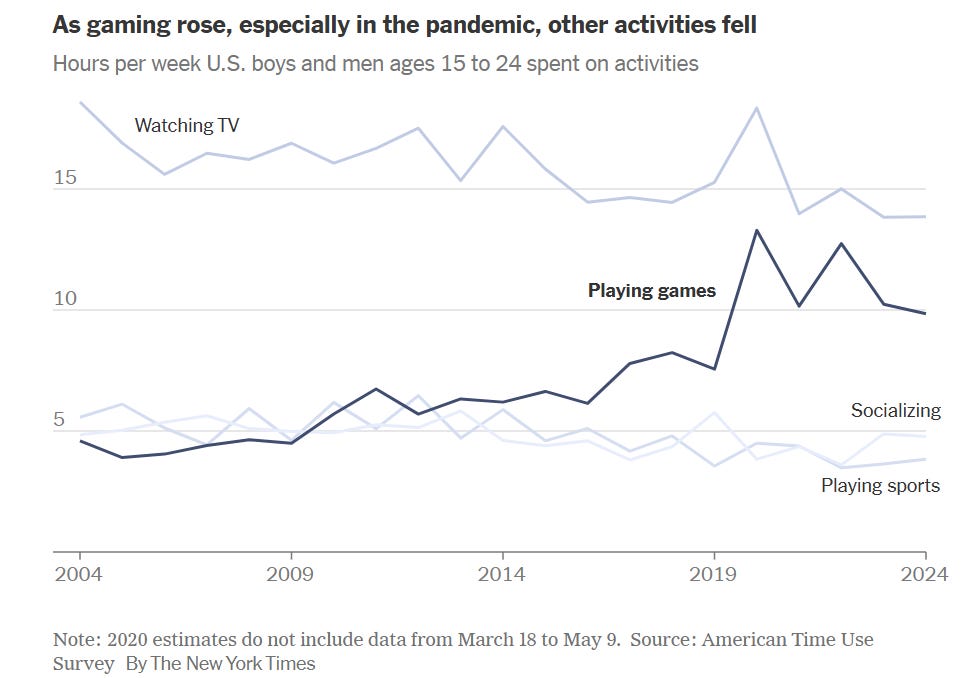
Fortnite, Minecraft and Roblox are popular titles amongst younger audiences, while Grand Theft Auto and Call of Duty, two games which have been around for decades, are Millennial favourites alongside action role-playing games like 2022’s Elden Ring, with the age cohort spending up to 22 hours per week on gaming (link).
Thirty-something males might not have been online-natives, but armed with full fibre broadband and burgeoning bank balances, they’re certainly trying to catch-up with their younger counterparts. And they’re increasingly not interested in what mainstream mass media has to say to them, unless it’s sports-related of course.
You won’t find the Millennial man at the library.